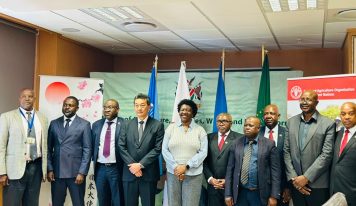
The Food and Agriculture Organization of the United Nations (FAO), in collaboration with the Ministry of Agriculture, Fisheries, Water and Land Reform (MAFWLR), officially opened the SADC Agricultural Information Management Systems (AIMS) Indicator Alignment Workshop on 12 January 2026 at the Swakopmund Plaza Hotel in the Erongo Region.
The five-day workshop brings together national and regional stakeholders to strengthen agricultural data systems, harmonize indicators, and enhance evidence-based decision-making across agriculture, fisheries, water and land sectors in line with SADC and continental frameworks, including the Comprehensive Africa Agriculture Development Programme (CAADP).
Opening the workshop, Dr. Patrice Talla, FAO Sub-Regional Coordinator for Southern Africa, emphasized that agriculture remains the backbone of Southern African economies, supporting food security, livelihoods, trade and resilience to climate shocks. He noted that weak, fragmented and non-harmonized data systems continue to constrain effective planning and policy-making.
Dr. Talla highlighted the SADC AIMS platform as a cornerstone for strengthening evidence-based agricultural governance, recalling that SADC Ministers of Agriculture have already endorsed the regional AIMS strategy and core indicators. However, he acknowledged persistent challenges such as data fragmentation, inconsistent indicators and limited interoperability between national systems.
He reminded participants of commitments made at the November 2025 regional SADC AIMS workshop, where Member States agreed to align national indicators with the SADC AIMS framework, upload at least 70 percent of their data, standardize metadata procedures, revitalize AIMS technical working groups and align national systems with CAADP reporting requirements.
Remarks on behalf of the Minister of Agriculture, Fisheries, Water and Land Reform, Inge I. Zaamwani, were delivered by Stephanus Sanda, Chief Statistician and SADC AIMS National Focal Point for Namibia. He underscored that effective, evidence-based policy-making depends on high-quality, integrated data, noting that data silos and inconsistent methodologies undermine the ability to understand the critical nexus between land, water, agriculture and fisheries.
Stephanus stressed that the workshop, held under the STOSAR II Project—Support Towards the Operationalization of the SADC Regional Agricultural Policy—is designed to bridge these gaps by promoting standardized frameworks, modern analytical tools and coordinated data sharing across the Ministry. Beyond technical skills, he highlighted the importance of developing a collaborative action plan to foster a culture of coordinated, evidence-driven decision-making.
The workshop was officially declared open with a call for active participation, knowledge sharing and sustained collaboration to ensure that agricultural data systems remain relevant, updated and widely used long after the training concludes.
The Workshop is expected to result in significant progress in aligning Namibia’s national data systems with regional and continental frameworks, strengthening the country’s contribution to collective monitoring efforts and supporting more coherent agricultural policy implementation across the region.